Practical
Sedona Weather by Month: Heat, Monsoon Storms and the Best Time to Visit
Sedona weather is high-desert weather: sunny most of the year, hot in summer, cool and occasionally snowy in winter, with a burst of thunderstorms in July and August. The town sits at about 4,360 feet, high enough to be far milder than the low desert around Phoenix, low enough to stay warmer than Flagstaff up on the plateau. By the long-term record of the Western Regional Climate Center, the average high runs from 56.0°F in January to 96.1°F in July, and the year brings 17.85 inches of rain and melted snow.
That range is why the answer to “when should I go?” depends on what you plan to do. Spring and fall suit long hikes. Summer suits early starts, creek swimming and stargazing. Winter is the quiet season, with cold nights, the odd dusting of snow on red rock, and the clearest air of the year. Below: the numbers month by month, what each season is actually like on the trails, the monsoon and its hazards, and how the weather shapes swimming, stargazing and tours.
Sedona weather by month at a glance
The figures come from the Western Regional Climate Center’s summary for its Sedona station, which covers a period of record from October 20, 1943 to November 14, 2010. They are long-term averages, not a forecast: any given week can run well above or below them.
| Month | Average high | Average low | Precipitation | Snowfall |
|---|---|---|---|---|
| January | 56.0°F | 30.8°F | 2.03 in. | 1.4 in. |
| February | 60.0°F | 33.3°F | 1.86 in. | 0.8 in. |
| March | 64.8°F | 36.6°F | 1.96 in. | 0.6 in. |
| April | 72.9°F | 42.3°F | 1.11 in. | 0.2 in. |
| May | 82.4°F | 49.8°F | 0.59 in. | none |
| June | 92.3°F | 58.1°F | 0.37 in. | none |
| July | 96.1°F | 65.1°F | 1.76 in. | none |
| August | 93.4°F | 63.8°F | 2.15 in. | none |
| September | 88.3°F | 58.2°F | 1.61 in. | none |
| October | 77.8°F | 48.6°F | 1.42 in. | none |
| November | 65.4°F | 37.6°F | 1.33 in. | 0.1 in. |
| December | 56.5°F | 30.9°F | 1.65 in. | 1.1 in. |
| Year | 75.5°F | 46.3°F | 17.85 in. | 4.2 in. |
Three things stand out. The wettest month is August, not winter, because of the summer monsoon. The driest is June, with just 0.37 inches. And the daily swing is large in every season: a January day that peaks in the mid-50s usually drops below freezing at night, and even July nights fall to about 65.1°F.
Why Sedona is milder than you might expect
Sedona sits in a basin at the foot of the Mogollon Rim, the long escarpment that marks the southern edge of the Colorado Plateau. Its elevation of 4,360 feet puts it in the middle of Arizona’s climate ladder. The low desert to the south bakes through summer; the forested plateau above the rim is cooler and much snowier. Sedona gets some of both, which is why its climate is often described as four distinct seasons rather than the endless summer people associate with Arizona.
Dry air does the rest. Low humidity lets the ground heat up fast under a clear sky and cool off fast after sunset, which explains the wide gap between day and night. It also means shade and wind make a big difference to how a given temperature feels. A 77.8°F October afternoon in the sun on bare slickrock can feel hot; the same afternoon in the shade of a sycamore by Oak Creek can feel cool.
Winter: December to February
Winter is Sedona’s quiet season, and for many visitors its best-kept secret. Average highs sit between 56.0°F and 60.0°F, comfortable for walking in a light jacket, and the sun is strong at this altitude. Nights are cold: the average low is 30.8°F in January and 30.9°F in December, so frost on the car in the morning is normal.
Snow does fall, but not much. The record averages 1.4 inches in January, 1.1 inches in December and 0.8 inches in February, and the average snow depth is zero: snow usually melts within hours or a day. A morning after a storm, with white on the red buttes and the San Francisco Peaks gleaming to the north, is one of the most photographed sights of the year.
Winter is also wet by Sedona standards. January averages 2.03 inches of precipitation, more than any month except August. Rain days can make dirt roads muddy and slickrock slippery, so check the forecast before a jeep tour or a scramble, and avoid steep rock when it is wet or icy.
The upside of winter is space. Trailheads and viewpoints are less crowded, the light stays low and warm all day, and the long nights suit stargazing.
Spring: March to May
Spring is the season most people picture when they think of hiking Sedona. March warms to an average high of 64.8°F, April to 72.9°F and May to 82.4°F, with nights climbing from 36.6°F to 49.8°F. Rain tails off fast: April averages 1.11 inches and May only 0.59 inches.
March can still bring a late storm, and its nights are cold; pack layers. April is close to ideal for long hikes. By late May, the middle of the day is hot on exposed trails, and the pattern of summer starts: walk early, rest at midday, go out again in the evening.
Spring is also busy. School breaks bring crowds to the best-known trailheads, and parking fills early. The Forest Service’s advice for its most popular trails applies across Sedona in spring: mornings and weekdays are least crowded.
June: the hottest, driest stretch
June is the month that catches visitors out. It is almost rainless, with an average of just 0.37 inches, and the average high reaches 92.3°F. The National Weather Service explains why: in June a ridge of high pressure sits over Mexico and blocks moisture, so northern Arizona normally sees some of its hottest and driest weather of the year.
That dryness has a second effect. The fire weather season in northern Arizona peaks near the end of June, which is normally the warmest and driest period of the year. In dry years the Forest Service may restrict campfires, smoking or access to parts of the forest; check current restrictions before you go.
June suits sunrise hikes, creek time and evenings outdoors. It does not suit a midday climb up an unshaded butte.
The monsoon: July to September
The summer monsoon is not a single storm but a seasonal wind shift that carries moist air north from the Gulf of California and the eastern Pacific. In northern Arizona, the National Weather Service says monsoon moisture typically does not reach the region until the first week of July. Much of the area receives 40-50% of its annual precipitation during the monsoon season.
You can see it in the Sedona record. July jumps to 1.76 inches of rain from June’s 0.37, and August is the wettest month of the year at 2.15 inches. September drops back to 1.61 inches.
The rain does not fall all day. According to the National Weather Service, it comes most days as afternoon and evening thunderstorms, and the Mogollon Rim, just north of Sedona, acts as a trigger for showers and storms on most days of the season. A typical monsoon day starts clear and hot, builds towering clouds by early afternoon, and breaks into a storm or two before sunset. Then the air clears, the rocks steam, and the evening can be spectacular.
Temperatures stay high. July is the hottest month on the record at 96.1°F, and August averages 93.4°F. Humidity rises too, so the heat feels heavier than in June.
In most years the monsoon begins to wind down in September, with longer breaks between rounds of storms. The NWS notes a twist: this late period can bring the most severe weather, when cooler Pacific troughs combine with lingering monsoon moisture.
Flash floods and lightning: the monsoon rules
The National Weather Service calls flash flooding the biggest threat in northern Arizona during the monsoon season. A storm over the rim can send water down a canyon or across a dry wash that never saw a drop of rain where you are standing. Its advice is blunt:
- Never drive through flood waters. The NWS notes that 12 inches of water can sweep a car off the road, and most flood deaths happen in vehicles.
- Watch the sky upstream. If clouds build over the rim, stay out of narrow canyons and creek beds, and do not cross a running wash.
- Lightning: no outside location is safe when thunderstorms are near. A substantial building or an enclosed, metal-topped vehicle is safe. Exposed ridges, summits and saddles are the worst places to be.
- Plan around the clock: do the long hike or the summit in the morning, and be back at the car before the storms build.
These rules matter most in canyon hikes. West Fork of Oak Creek is the classic example: an easy walk with stream crossings in fair weather, and a place to avoid when storms are forecast upstream.
Fall: October and November
For many people this is the best time of year in Sedona. September eases to an average high of 88.3°F, October to 77.8°F and November to 65.4°F, while nights cool from 58.2°F to 37.6°F. October averages 1.42 inches of rain and November 1.33 inches, with the occasional early storm.
Fall also brings color. The Forest Service describes West Fork in autumn as ablaze with color, with red and gold leaves floating in clear pools, and sycamores, cottonwoods and maples along Oak Creek turn through late October and November. It is a popular time, so the same rule applies: arrive early and avoid weekends if you can. In 2026, note that a Forest Service order closes the West Fork area from September 26, 2026 through October 31, 2026, after the Pocket Fire left the watershed prone to rockfall and flood debris; check the forest’s alerts before you go.
By late November, mornings are cold again. The first snow of the season sometimes arrives before December, though the record averages just 0.1 inches for November.
Weather and hiking: when to walk
Most Sedona trails cross open, sunny ground with little shade. That makes the season and the hour more important than the distance.
- Fall, winter and spring: most trails are comfortable at any time of day. In winter, start after the frost has gone from steep rock.
- Late May to September: start at first light. The NWS heat advice is to drink plenty of water, wear light clothing and plan outdoor activity early in the morning or late in the evening.
- Monsoon afternoons: be off exposed rock and out of canyons before the storms build.
- After rain or snow: wet slickrock is slick; mud on dirt roads can stop a car.
The canyon trails in Oak Creek run cooler than the open buttes around town, which makes them summer favorites. The open trails around Bell Rock, Cathedral Rock and the airport mesa are better in the cool months. For trail-by-trail choices, our article on hiking in Sedona compares the popular routes.
Weather and water: swimming in Oak Creek
When it is hot, the place to be is Oak Creek. Slide Rock State Park, a 43-acre historic apple farm in Oak Creek Canyon, is the best-known swimming spot, with a natural rock slide in the creek. Its hours change with the season:
- January 31 to November 20: open 8 a.m. to 6 p.m.; entry and the swim area close at 5 p.m.
- November 21 to January 30: open 9 a.m. to 5 p.m.; entry and the swim area close at 4 p.m.
Prices change with the season too. From May to August 21, 2026 the entrance fee is $30.00 per vehicle for one to four people; from August 22, 2026 to April 2027 it is $20.00. Additional people pay $5.00, and children under 6 are free. The park takes no reservations, admits visitors only by vehicle, and asks people not to line up on the road before opening or when the lot is full. On hot summer days, that means arriving early. Pets are not allowed in the park between May 1 and September 30.
Red Rock State Park, by contrast, is a 286-acre nature preserve with no swimming and no pets. It suits a cool-season visit: a family-oriented 5-mile network of trails, and a guided nature walk with a volunteer naturalist daily at 10 a.m.
In monsoon season, creek levels can rise fast after a storm upstream. Leave the water if it turns muddy or starts to rise.
Weather and night skies
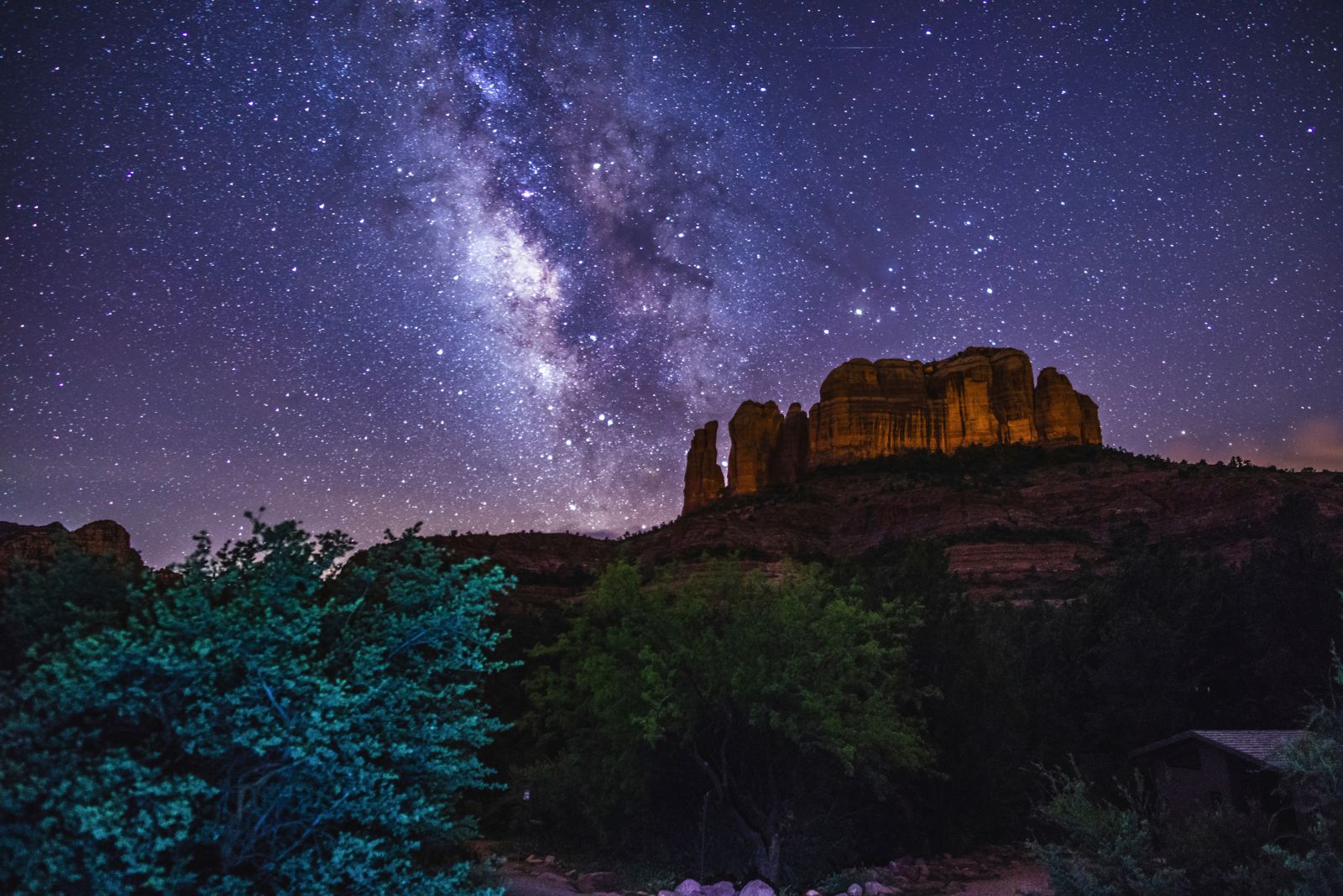
Sedona’s dry air and clear skies make the night half of the visit. In 2014 the International Dark-Sky Association designated Sedona the world’s eighth International Dark Sky Community, recognizing residents who had worked on the problem since Keep Sedona Beautiful was founded in 1972, and an outdoor lighting ordinance that became law in 2001.
The best nights depend on the season:
- Winter: long, crisp nights and very clear air. Dress for temperatures near freezing.
- Spring and fall: comfortable evenings and generally clear skies.
- Monsoon season: storms often clear by late evening, but cloud can linger. Plan a flexible night.
DarkSky suggests planning a stargazing night around the new moon and astronomical twilight. Red Rock State Park holds star parties with the Astronomers of Verde Valley (registration required), and guided stargazing tours run from town; see the options on our tours page.
Weather and tours
Most Sedona tours run year-round, but the weather changes the experience.
- Open-air jeep tours are at their best in spring and fall. In summer, morning and evening departures avoid the worst heat, and monsoon storms can shorten or cancel afternoon trips.
- Stargazing tours depend on clear skies; winter nights need warm layers.
- Hot-air balloon flights fly at dawn in calm air, and are the most weather-sensitive of all. Expect cancellations on windy or stormy days.
- Day trips from Phoenix are easiest in the cool months, when the drive and the walking at stops are both comfortable.
Our comparison of Sedona tours sets the options side by side. If your dates are fixed, book the weather-sensitive activities early in your stay, so a cancellation can be moved to another day.
The best time to visit Sedona
There is no bad month, only a wrong plan. Matched to what you want:
- For hiking: late March to May and late September to November. April and October are close to ideal.
- For fewer crowds: December to February, with cold nights and bright days.
- For swimming in Oak Creek: June to early September, starting early in the day.
- For photography: winter after a storm, monsoon evenings, and fall color in the canyons.
- For stargazing: winter and the new moon of any month.
- To avoid: midday hikes from June to August, and canyon hikes on monsoon afternoons.
If Sedona is part of a wider Arizona trip, it also works as a cooler stop between the low desert and the high plateau: warmer than Flagstaff in winter, cooler than Phoenix in summer. Our guide to getting to Sedona from Phoenix and Flagstaff covers the drive and the shuttles, and the FAQ answers the planning questions.
Frequently asked questions
What is the hottest month in Sedona?
July, with an average high of 96.1°F on the Western Regional Climate Center record. June (92.3°F) and August (93.4°F) are close behind. June is the driest; August is the wettest month of the year.
Does it snow in Sedona?
Yes, but lightly. The record averages 4.2 inches a year, mostly in December, January and February, and the average snow depth is zero because it melts quickly. Snow on the red rocks rarely lasts beyond a day.
When is monsoon season in Sedona?
The National Weather Service’s monsoon season runs through the summer, but in northern Arizona the moisture typically arrives in the first week of July. Storms come mostly in the afternoon and evening, and in most years taper off in September.
Is Sedona too hot in summer?
Days are hot, with average highs of 92.3°F to 96.1°F from June to August, but nights cool to around 58.1°F to 65.1°F. Hike at dawn, spend midday by the creek or indoors, and go out again in the evening.
What is the best month to visit Sedona?
For most visitors, April or October: warm days, cool nights, little rain and the best hiking weather. Winter is the quiet alternative, with fewer people and cold nights.